How much does land clearing cost per acre in Tennessee?
Published 2026 cost guides put land clearing in Tennessee at roughly $1,300 to $4,500 per acre. That range comes from the OWNR OPS Tennessee state guide. National guides land in the same neighborhood. LawnStarter puts a typical job at $1,266 to $3,900, with a $2,581 average. Lawn Love says $1,565 to $4,520, with most owners paying near $2,900.
Those are market numbers pulled from cost guides, not our price list. Every land clearing job gets priced off the actual ground. An acre of scattered saplings and an acre of solid privet are not the same work. Use the ranges below to build a budget, then get a real number from someone who has seen the property.
What drives the cost of clearing an acre?
Contractors are really selling machine days. The acre count per day is what swings. Published production benchmarks put a mulching machine at half an acre to two acres a day. Hand cutting with saws drops to a quarter acre. Open ground with a dozer runs one to three acres.
Same machine, same daily cost, very different acre totals. That is why one quote reads $1,200 an acre. The next reads $4,000 for ground that looks alike from the road.
Around Hamilton County, four things move the number most.
- Stem count. Privet and kudzu thickets pack far more stems per acre than open woods. More stems means more passes.
- Slope and rock. Ridge sides above the valley floor slow a machine down. East Tennessee cost guides call out shale and limestone outcrops as a real factor.
- Access. A back lot behind a house with a narrow gate needs a smaller machine and more hours.
- Where the material ends up. Chips left on site cost nothing to haul. Piles that leave the property cost real money.
What does clearing cost by how thick the growth is?
Cost guides sort clearing by growth density, because that is what sets production. Here is where the 2026 numbers sit.
| Ground condition | Tennessee published range | National published range |
|---|---|---|
| Light brush and grass | $975 to $1,560 per acre | $580 to $2,500 per acre |
| Medium brush with small trees | $1,430 to $2,210 per acre | $1,200 to $3,500 per acre |
| Heavy forest with large trees | $2,080 to $3,250 per acre | $3,300 to $6,700 per acre |
| Forestry mulching | $1,105 to $1,950 per acre | $1,800 to $4,000 per acre |
| Clearing plus stump grubbing | $2,600 to $4,160 per acre | $150 to $500 per stump |
Sources: the OWNR OPS Tennessee and national land clearing guides, LawnStarter, Lawn Love, and the Skidsteers.com brush clearing guide, all 2026 editions.
Two things to notice. The Tennessee ranges sit lower and tighter than the national ones on the heavy end. The rows also overlap, because the guides average jobs from all over the country. A flat acre of scrub on the valley floor is not the same as an acre on a ridge side.
What else lands on a land clearing bill?
Most quotes cover cutting and knocking the growth down. The add-ons are where budgets break.
Stumps are the biggest one. National guides put stump grinding at $150 to $500 per stump, and full extraction at $250 to $800. Lawn Love lists $130 to $350 per stump. A wooded acre can carry dozens of them.
Hauling debris off site runs about $500 to $2,000 an acre in the OWNR OPS data. Mobilization, the cost of getting equipment to the property, adds $300 to $1,500. Rough grading is its own trade and its own bill at $1,000 to $3,000 an acre. Permits and surveys show up too. Lawn Love lists clearing permits around $200 to $250.
Does forestry mulching cost less than clearing and hauling?
On a residential lot, usually yes. A mulcher cuts and grinds the growth where it stands, and the chips stay on the ground as cover. Nothing gets piled, loaded, or trucked away.
The Tennessee guide puts forestry mulching at $1,105 to $1,950 an acre. National guides quote a wider band at $1,800 to $4,000 an acre, or $150 to $250 an hour. The savings come from the line items that disappear. No pile, no haul-off, no dump fees.
Mulching has limits. It does not pull stumps out of the ground. If the acre is headed for a building, a site contractor still has to grub them out. That is separate work at a separate price.
Do you need a permit to burn cleared brush around Chattanooga?
Yes, and the window is narrow. Hamilton County allows open burning from October 1 through April 30. The Chattanooga-Hamilton County Air Pollution Control Bureau issues the permit and takes applications at 423-643-5970. From May 1 through September 30, open burning is closed across the county.
The bureau’s published fees are $15 for county residents and $75 inside city limits. City permits require an inspection first. A standard permit covers less than two acres of brush in a burn season. Burning more than that takes a $625 controlled burn permit.
Three rules catch people out.
- Only clean, raw, untreated, non-manufactured wood or natural vegetation may burn. The prohibited list names stumps, plywood, treated or painted wood, plastics, and roofing material.
- The material has to come from the burn site address. Debris hauled in from another property cannot be burned.
- Tennessee also requires a free state burn permit from the Division of Forestry between October 15 and May 15. Stricter local rules override the state program.
Timing is a real budget item here. Clear a lot in June and burning is off the table. The pile either sits until fall, gets mulched in place, or gets loaded out. That last option is what our junk and debris removal with the dump trailer is for.
Will a logger pay you for the timber?
On most residential properties, no. Logging crews need enough merchantable volume to fill trucks and cover the cost of moving equipment in. Forestry extension guidance puts the practical floor around 10 to 20 acres of harvestable timber.
Below that, the math stops working. Moving a crew and machines to a job is a fixed cost. It has to spread across the volume that leaves the property.
When a harvest does pencil out, landowners typically receive about half the log value. Published figures put that at roughly $500 to $5,000 an acre. Species, tree size, and distance to a mill move it. Loggers also take the trunks and leave the tops, slash, and stumps. That leftover material is the part that costs money to clear.
Residential clearing and heavy timber clearing are two different jobs
The heavy timber numbers above describe a different trade. Those crews run dozers, excavators, and log trucks across large acreage. That is production forestry work.
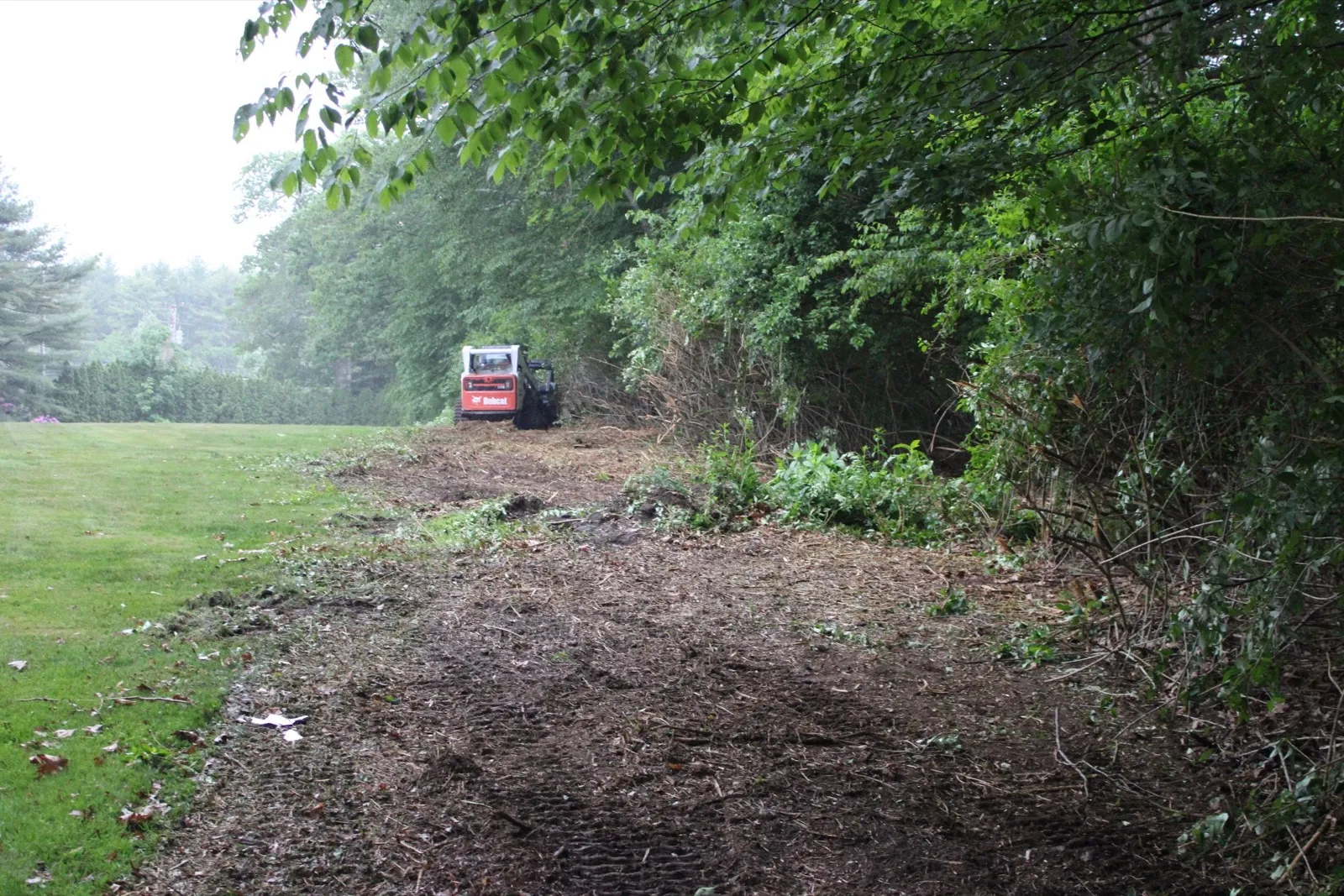
Most calls around Chattanooga are not that. They are a half acre gone wild behind the house. A grown-up fence line. Two acres of privet and saplings that used to be pasture. That is residential scale, and it runs on smaller equipment.
Our mini skid steer fits through a standard fence gate. It carries a drum mulcher, a rotary brush cutter, and a Harley rake. That setup handles brush, saplings, and small trees on tight lots without tearing up the rest of the yard. For open fields and pasture that only need knocking back, brush clearing with the rotary cutter is the cheaper path.
Mature hardwood timber is not our lane. A property that needs that work needs a logging outfit.
Getting a real number for your property
Cost guides give you a range. The property gives you a price. A free estimate means someone comes out and looks at the growth and the access. Then you get a real number for the job.
Three Crosses Land Services is a veteran-owned family business based just north of Chattanooga, TN. We are licensed and insured, and we cover Chattanooga, Southeast Tennessee, and Northwest Georgia. For residential land clearing on your lot or acreage, call or text (423) 260-5675 and we will set up the estimate.