
How much does a French drain cost in Tennessee?
A yard French drain costs about $10 to $65 per linear foot installed in 2026. Cost listings for the Chattanooga area sit tighter, at $22 to $35 per foot. A common 60 foot backyard run lands near $1,350 to $2,100 there. National guides put the average French drain project around $5,000. That figure is pulled up by big interior basement systems. Most wet yards never need one.
Those are published market ranges from national and regional cost guides. They are not our price list. The French drains we install get priced off the property itself. The ground decides how deep the trench goes and where the water can be sent.
What does a yard French drain cost per foot?
Per foot is how this work gets priced, so the length of the run does most of the math. Here is what the published guides list.
| Job | Published cost |
|---|---|
| Yard drain, per linear foot | $20 to $30 |
| Exterior drain, per linear foot, full range | $10 to $65 |
| Chattanooga area, per linear foot | $22 to $35 |
| 20 foot run, Chattanooga | $450 to $700 |
| 40 foot run, Chattanooga | $900 to $1,400 |
| 60 foot run, Chattanooga | $1,350 to $2,100 |
| 100 foot run, Chattanooga | $2,240 to $3,500 |
| 100 foot run, national range | $1,000 to $6,500 |
| Interior basement drain, per linear foot | $40 to $100 |
Sources: Fixr for the yard and interior per foot rates, LawnStarter for the exterior range and the national 100 foot total, and HomeBlue’s Chattanooga cost page for the local per foot rate and run totals.
Two things stand out. The local Chattanooga numbers land in the middle of the national band, not at the bottom. And a plain yard drain costs a fraction of what an interior basement system runs.
What drives the price of a French drain?
Depth is the first lever. A surface drain under a foot deep is the cheapest kind to cut. Once the trench goes 2 to 4 feet down, the digging takes longer and there is far more spoil to move. HomeBlue’s guide names depth as the main reason its Chattanooga range spreads from $22 to $35.
Length is the second. The rate is per foot, so a 40 foot run and a 120 foot run are not close. Most yards need less pipe than the owner expects. The drain only has to cover the wet strip and reach an outlet.
Where the water goes is the one people forget. An outlet to daylight at a low corner of the property is the cheapest ending a drain can have. When the ground has no fall, the water needs somewhere else to sit. LawnStarter lists dry wells at $500 to $3,000. Lawn Love puts a sump pump at $625 to $2,625 on top of the drain itself.
Then there is what is in the way. Tree roots, buried utility lines, a patio, a walk, or a driveway crossing the run all add labor. Rock under the sod does the same. Fixr lists labor at $35 to $75 per hour, so anything that slows the trench shows up in the total.
Materials are a smaller share than most people guess. LawnStarter prices perforated pipe at $0.50 to $3 per linear foot. Drainage gravel runs $25 to $53 per ton, and landscape fabric $0.45 to $0.80 per square foot. What you are really paying for is the digging, the hauling, and putting the yard back. Permits, where they apply, run $58 to $225 by the same source. Fixr lists inspection at $150 to $250.
French drain, downspout extension, or regrading?
These three get talked about together, and they fix different problems.
An underground downspout extension is the cheapest of the three. It is often the right first move. Cost guides put it at $3 to $8 per linear foot of added line. Per downspout, they list roughly $150 to $350 for a catch basin, buried pipe, and a pop up outlet. A roof sheds a lot of water in one spot. If your gutters dump beside the foundation and that corner stays soft, moving that water 20 feet out can solve it.
A French drain is for water already in the ground or standing in a low spot. It catches water along a run and carries it off. That is the fix for a soggy strip along a fence. It also suits a back corner that stays wet for days after rain.
Regrading is reshaping the ground so water leaves on its own. Published ranges put it at $0.40 to $2.00 per square foot. That works out to about $500 to $1,000 for a small lawn and $1,000 to $5,000 for a backyard. Regrading is dirt work, and it is not what we take on. If someone has told you the yard needs reshaping, that is a different contractor.
Plenty of properties around here need the first two together. Get the roof water out to a real outlet, then drain the low ground that stays wet.
Why do Tennessee clay yards stay wet?
Two reasons, and they stack.
The first is rain volume. Chattanooga averages about 55 inches of rain a year under NOAA’s 1991 to 2020 climate normals. That is well above the national average. A good share of it falls in winter and early spring. Nothing is growing then, and the ground is already full.
The second is the soil. The red clay across Hamilton County and Northwest Georgia is made of very fine particles packed tightly together. It has little of the pore space that sandy soil has. Tennessee drainage contractors describe the same behavior: the clay swells when it rains and seals at the surface. Water stops soaking in. Once clay is saturated it holds that water for days. A University of Tennessee Extension write up names poor drainage as a leading cause of plant death in landscapes here.
Add the terrain and it gets worse. Soddy-Daisy sits in the valley between Walden’s Ridge and Chickamauga Lake. Runoff comes off higher ground and collects on the flats. If the flat spot is your backyard, that water has nowhere to go and no soil that will take it.
That is why a drain in clay lives or dies on its outlet. The gravel trench gives water an easy path it cannot find in the surrounding dirt. The pipe has to actually take it somewhere.
What happens on install day
The order of work is simple: dig, line, rock, pipe, rock, cover.
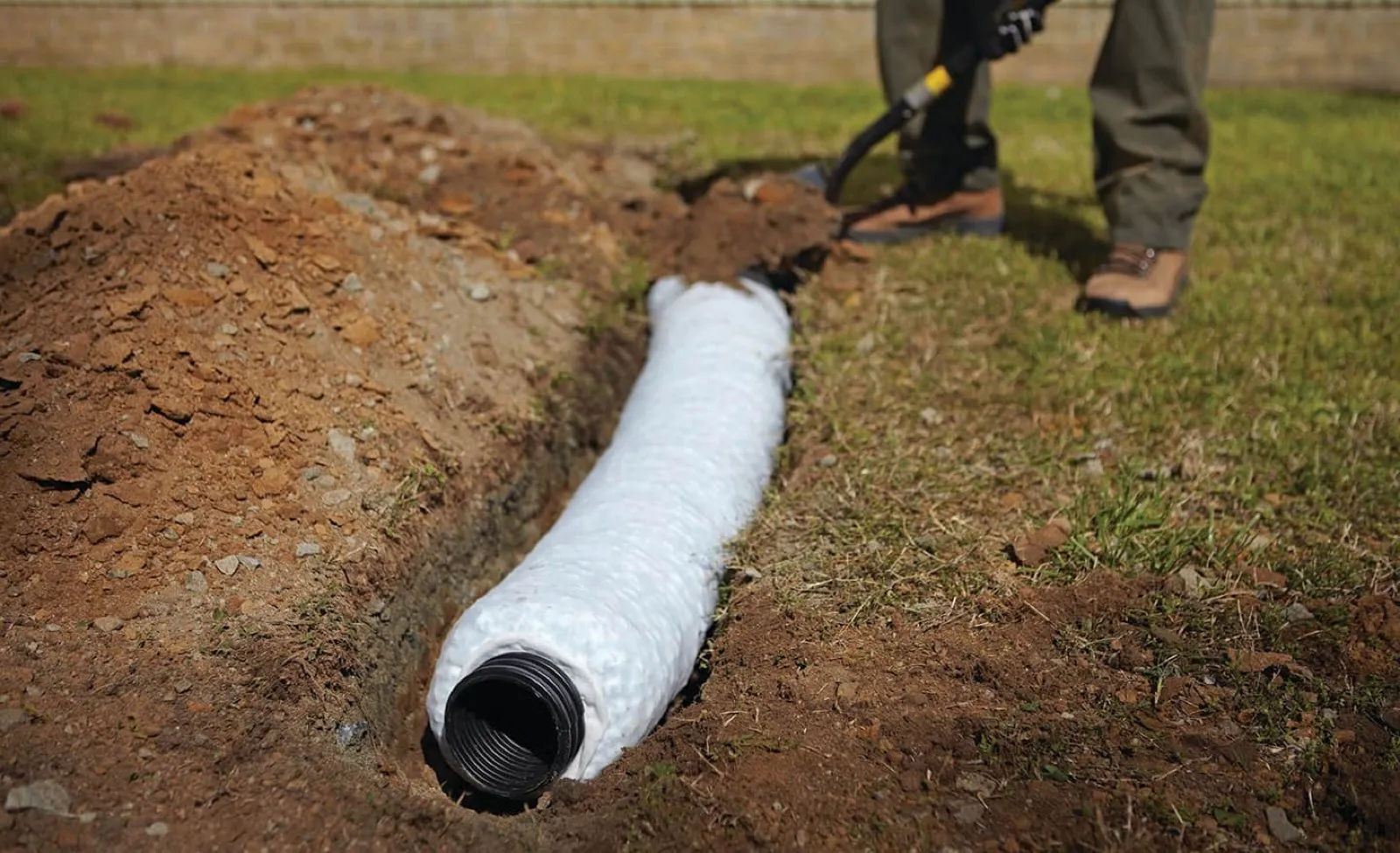
The trench gets cut along the wet run at the depth the water needs. Fabric lines it so soil does not silt the stone up over time. Washed gravel goes in the bottom, then perforated pipe, then more gravel on top. The fabric folds over that, and soil or sod goes back on.
A short backyard run across open lawn is usually a one day job. Longer runs, hard digging, and an outlet that has to travel to reach daylight add time. Roots, buried lines, and a trench that has to cross a walk or a drive slow it down further. Soaked ground can push a start date. A trench cut in wet clay is hard to dig and harder to backfill.
Access matters as much as length. Our mini skid steer fits through a standard fence gate. So a wet spot in a fenced backyard does not mean hand digging the whole run.
Runoff hurts more than lawns. Water crossing a gravel drive scours the fines out and leaves ruts and potholes behind. If that is happening on your place, gravel driveway repair is the other half of the same fix.
What we need to quote your drain
Send the address and tell us where the water sits. A photo or a short video the day after a hard rain is worth more than any description. Tell us whether the gutters already run underground, and how far it is to a low spot or a ditch. Say if the wet area sits behind a fence.
From there we come look at it and price the run off what the ground actually shows. The estimate is free.
Call or text Three Crosses Land Services at (423) 260-5675, or send the form.
Sources used for the ranges above: LawnStarter, Lawn Love, Fixr, HomeGuide, Angi, HomeBlue’s Chattanooga French drain cost page, NOAA 1991 to 2020 climate normals for Chattanooga, and University of Tennessee Extension material on poorly drained soils.