How much does bush hogging cost per acre in Tennessee?
Custom bush hogging in Tennessee averaged $47.50 an acre in a 2023 University of Tennessee Extension survey. Rates ran from $15 to $75. Those are farm-to-farm rates on open hay and pasture ground. For an overgrown lot around Chattanooga, treat that number as the floor, not a quote.
Contractor figures run higher. GreenPal, which surveyed lawn care pros on their rates, puts relatively open pasture at around $100 an acre. By the hour, its range for a 6 foot cutter is $85 to $120.
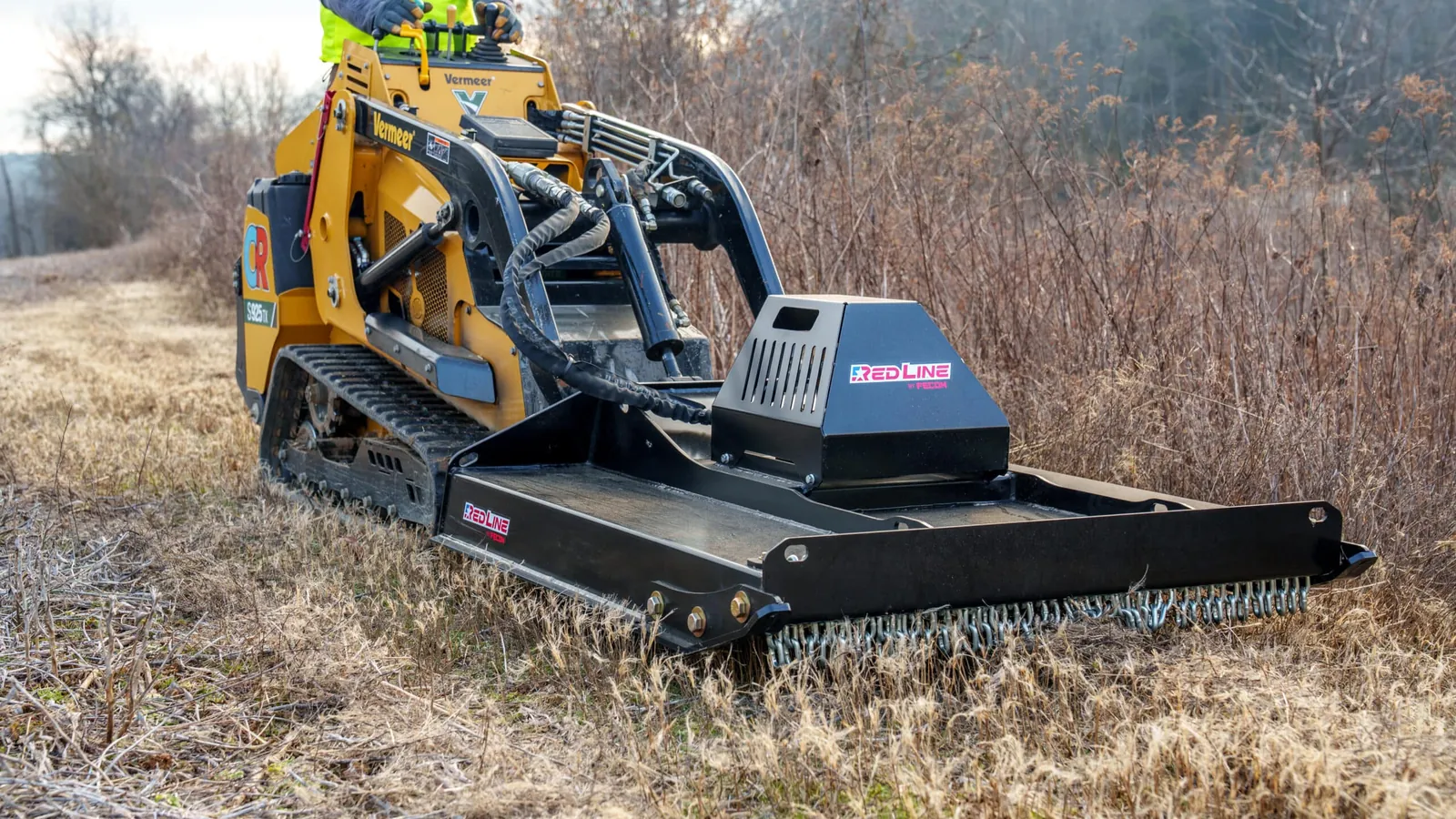
These are market figures from Extension surveys and national cost guides, not a price sheet from us. Three Crosses Land Services handles brush clearing and bush hogging with a rotary brush cutter on a mini skid steer.
The machine fits through a standard fence gate. The cutter takes grass, weeds, briars and saplings up to about three inches thick. We cut fields, pastures, vacant lots, trails and the ground around barns.
What do published bush hogging rates look like?
The Tennessee survey runs $15 to $75 an acre. GreenPal’s contractor range is $85 to $120 an hour, with open pasture at about $100 an acre.
| Bush hogging rate | Published figure | Source |
|---|---|---|
| Tennessee custom rate per acre, 10 responses | $15 to $75, average $47.50 | UT Extension, 2023 survey |
| Mississippi custom rate per hour, 5 responses | $30 to $125, average $72 | Mississippi State Extension, 2024 survey |
| Tractor and 6 foot cutter, per hour | $85 to $120 | GreenPal |
| Relatively open pasture, per acre | About $100 | GreenPal |
| Minimum charge | 2 to 3 hours, or a flat show-up fee | GreenPal |
Both surveys are small. The Tennessee average comes from 10 responses, and the Mississippi hourly average comes from 5. Mississippi State University Extension surveyed producers across that state in the spring and summer of 2024.
GreenPal’s figures come from contractors who cut for hire. Its hourly range assumes a tractor pulling a 6 foot cutter, and its per acre benchmark assumes relatively open pasture.
Why is the Tennessee survey number only a floor?
It prices the easiest version of the job, open farm ground cut by one farmer for another. UT Extension collected the rates from Tennessee producers who charged to harvest hay or paid another producer to do it. UT notes the figures are rates charged, not the cost of production.
Open ground at full speed goes fast. GreenPal says a 6 foot cutter covers about 2.4 to 3 acres an hour in perfect conditions. At $85 to $120 an hour, that works out to about $28 to $50 an acre. The Tennessee average of $47.50 sits inside that range.
GreenPal notes that real-world speeds are often slower. At 1.5 to 2 acres an hour, a contractor has to charge more per acre. A field of grass also cuts faster than a lot full of saplings and briars.
Take a 5 acre pasture. At the Tennessee average, it comes to $237.50. At GreenPal’s $100 an acre benchmark, it is about $500. If those 5 acres have grown up in briars and saplings, GreenPal’s pricing adds a surcharge for heavy growth.
Is bush hogging priced per acre or per hour?
Both, and the ground decides which. GreenPal tells contractors to price open fields per acre. Obstructed or uncertain ground gets an hourly rate, often with a 2 to 3 hour minimum.
Per acre fits a pasture that looks the same from one fence to the other. Hourly fits ground where nobody can see what the tall grass hides until the cutter gets there.
Either way, a hired rate sits above the cost of running the machine. Mississippi State says custom work carries an expected markup of 20 to 40 percent over operating cost. Part of that markup covers surprise repairs from running equipment on unfamiliar ground.
Why does a small lot cost more per acre?
The minimum does not shrink with the lot. GreenPal says many pros set a 2 to 3 hour minimum or a flat show-up fee. It pays for hauling and setup. It also covers the risk of hitting something that breaks a blade.
Run the numbers on half an acre. At the Tennessee survey average, half an acre comes to about $24. GreenPal’s point is simple: without a minimum, small jobs often lose money once fuel and transport are counted.
At GreenPal’s rates, a 2 to 3 hour minimum comes to $170 to $360. Spread over half an acre, that is $340 to $720 an acre. The cutting itself goes quickly. At GreenPal’s speeds, a 6 foot cutter mows half an acre of open ground in about 10 to 20 minutes.
Fenced lots are part of this work. Our mini skid steer fits through a standard fence gate, so backyards and back lots stay in reach.
What pushes the price up?
Anything that slows the cutter down or puts the machine at risk. GreenPal tells contractors to list surcharges for debris removal, rocks, slopes, re-cuts and off-haul before the job starts.
How tall and how old the growth is. The Chattanooga airport station averages about 55 inches of rain a year, and brush grows hard here. Skip a field for one season and it comes back waist high in weeds and briars. A first cut on ground left alone for several years takes longer than a yearly maintenance cut. Many fields get cut once in spring and once in late summer to stay ahead of it.
Saplings. Our cutter handles saplings up to about three inches thick. Heavy growth takes two passes, one high to knock it down and one low to finish. Past three inches, a blade is the wrong tool.
Slopes, rocks and soft ground. GreenPal says contractors push toward the top of the hourly range on ground with rocks, slopes or debris. Soft spots slow the machine down as well.
What hides in the grass. Old wire, tires and dumped trash hide in tall grass, so point them out before we start. Well heads and survey stakes get marked before the cutter turns. Getting junk off the property is junk and debris hauling, which is separate work.
Access. A gate the machine can drive through and a short pull from the trailer keep the hours down. A long run to a back field adds time before any cutting starts.
Where does bush hogging stop and brush removal start?
For our cutter, it stops at saplings about three inches thick. Brush removal is a bigger job that clears brush off the land. HomeGuide prices it at $800 to $3,000 an acre, and its cleanup prices typically include hauling and disposal.
| Job | Published range | Source |
|---|---|---|
| Brush removal, light brush with no trees or a few young ones, per acre | $800 to $1,800 | HomeGuide |
| Brush removal, heavy brush that is half brush and half trees, per acre | $1,600 to $3,000 | HomeGuide |
| Brush removal minimum fee, per visit | $250 to $600 | HomeGuide |
| Brush pile removal, per pickup truck load | $150 to $200 | HomeGuide |
| Hauling labor, per hour | $50 to $80 | HomeGuide |
The gap is wide. The bottom of HomeGuide’s light brush range is more than 16 times the Tennessee bush hogging average. Cutting growth down and leaving it in place is a much smaller job than clearing it off the land.
Heavier ground has other answers. A drum mulcher grinds brush and small trees into chips where they stand. Our guide to forestry mulching cost per acre covers those published ranges. Bigger trees and heavy woody growth call for land clearing, and our land clearing cost guide lays out those numbers.
Some ground needs a different service. Once kudzu or privet has taken over, that is kudzu and invasive plant removal rather than a mowing pass. Property lines grown thick with privet fall under fence line clearing, and we can price that on the same estimate.
What happens to the cut material?
On most bush hogging jobs, nothing leaves the property. The cutter chops the growth into small pieces that drop and break down in the field. Hauling only comes up when a job leaves a pile, and that costs extra.
HomeGuide prices brush pile removal at $150 to $200 per pickup truck load. It counts one full-size truck load as 2 to 4 cubic yards of brush. Hauling labor runs $50 to $80 an hour in the same guide.
When a job leaves a pile, we can grind it in place with the mulcher. Hauling it off in our dump trailer falls under yard waste removal.
Burning a pile follows county rules. The Chattanooga-Hamilton County Air Pollution Control Bureau opens burn season on October 1. It takes permit applications ahead of that date. The bureau also lists chipping or grinding brush and reusing the chips as an alternative to burning.
Curbside pickup has limits too. Red Bank does not pick up brush generated by contractors hired to work on private property. That brush stays the contractor’s job to clear away.
Getting a real number for your field or lot
Survey numbers set a floor, and the ground sets the price. A free estimate puts someone on the property to look at the growth and the way in. Photos of the thickest corner and the gate help us size the job before the visit.
Send the address and a rough acreage. Mention anything hiding in the grass and how long it has been since the last cut.
Every dollar figure above comes from an Extension survey or a cost guide, or from simple math on one. None of it is a Three Crosses Land Services price, and we do not price ground we have not seen.
Three Crosses Land Services is a veteran-owned family business based just north of Chattanooga, TN. We are licensed and insured, and we cover Chattanooga, Southeast Tennessee, and Northwest Georgia. To get an overgrown field or lot cut back to usable ground, call or text (423) 260-5675.